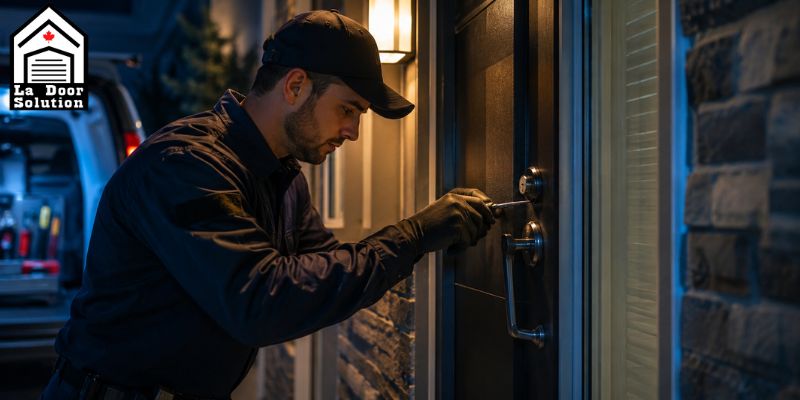


A garage door problem rarely happens at a convenient time. It may refuse to open when you are leaving for work, become stuck after a freezing night, or suddenly drop out of alignment when you are trying to get the car inside. When the door is your main vehicle entrance, even a relatively small mechanical fault can quickly become an urgent household problem.
That is where 24/7 emergency garage door repair Edmonton services can become important. Emergency repair is not simply about getting the door moving again. A proper assessment should identify why the failure occurred, make the system safe, and determine whether the damaged component can be repaired or needs replacement.
For Edmonton homeowners, weather, frequent temperature changes, accumulated moisture, and normal mechanical wear can all affect garage door components. Knowing which problems require immediate attention can help you avoid making a small fault worse.
This guide explains the warning signs, what you can safely check yourself, when professional assistance is appropriate, and what to expect from an emergency repair visit.
A garage door is a large moving system made up of interconnected components. Depending on the installation, these can include springs, cables, rollers, tracks, hinges, brackets, an opener, safety sensors, and various fasteners.
If one component fails, another component may be forced to carry more load than it should.
For example, a damaged roller can create additional resistance. The opener may continue attempting to move the door, placing extra strain on its motor and drive mechanism. Similarly, a broken spring can make the door extremely difficult or unsafe to lift manually.
This is why Emergency Garage Door Problems in Edmonton should not automatically be treated as minor inconveniences.
Some situations are particularly urgent:
The safest approach is to stop operating the system when continued use could cause additional damage or injury.
Not every garage door issue requires a technician immediately. A remote-control battery, for example, can often be replaced by a homeowner.
An emergency becomes more likely when the door is creating a safety risk, preventing essential access, or has suffered a mechanical failure that should not be operated without inspection.
A garage door won’t open emergency can occur for several reasons.
The opener may have lost power, the remote may not be communicating with the receiver, the wall control may have a problem, or a mechanical component may have failed.
Before assuming the opener itself is defective, check whether:
Do not repeatedly press the opener button if the motor is running while the door remains stationary. That can indicate a mechanical problem rather than a simple control issue.
If you can hear the motor operating but the door does not move, professional diagnosis is generally the safer option.
A garage door stuck closed is especially frustrating when your vehicle is inside.
The important question is why the door is stuck.
It could be caused by a broken spring, damaged cable, track obstruction, seized roller, opener fault, or another mechanical issue. These causes require different solutions.
One common mistake is trying to force the door upward. A garage door can be surprisingly heavy, and a failed counterbalance system can make manual lifting dangerous.
If the door feels unusually heavy, crooked, or unstable, stop trying to lift it.
A qualified technician can assess the counterbalance system and determine whether the problem is isolated to one component or whether several parts have been affected.
A door stuck halfway deserves particular caution.
The door may be under uneven tension, and the remaining weight may not be properly supported. Standing underneath it or attempting to manually reposition it can create unnecessary risk.
Keep people and vehicles away from the opening until the problem has been assessed.
Some garage door problems happen outside normal business hours. Others become emergencies because delaying the repair could expose your property or create a safety hazard.
Garage door springs counterbalance the weight of the door. When a spring breaks, the door can become extremely heavy.
You may hear a loud snap, find a visible gap in a torsion spring, or notice that the door suddenly became difficult to lift.
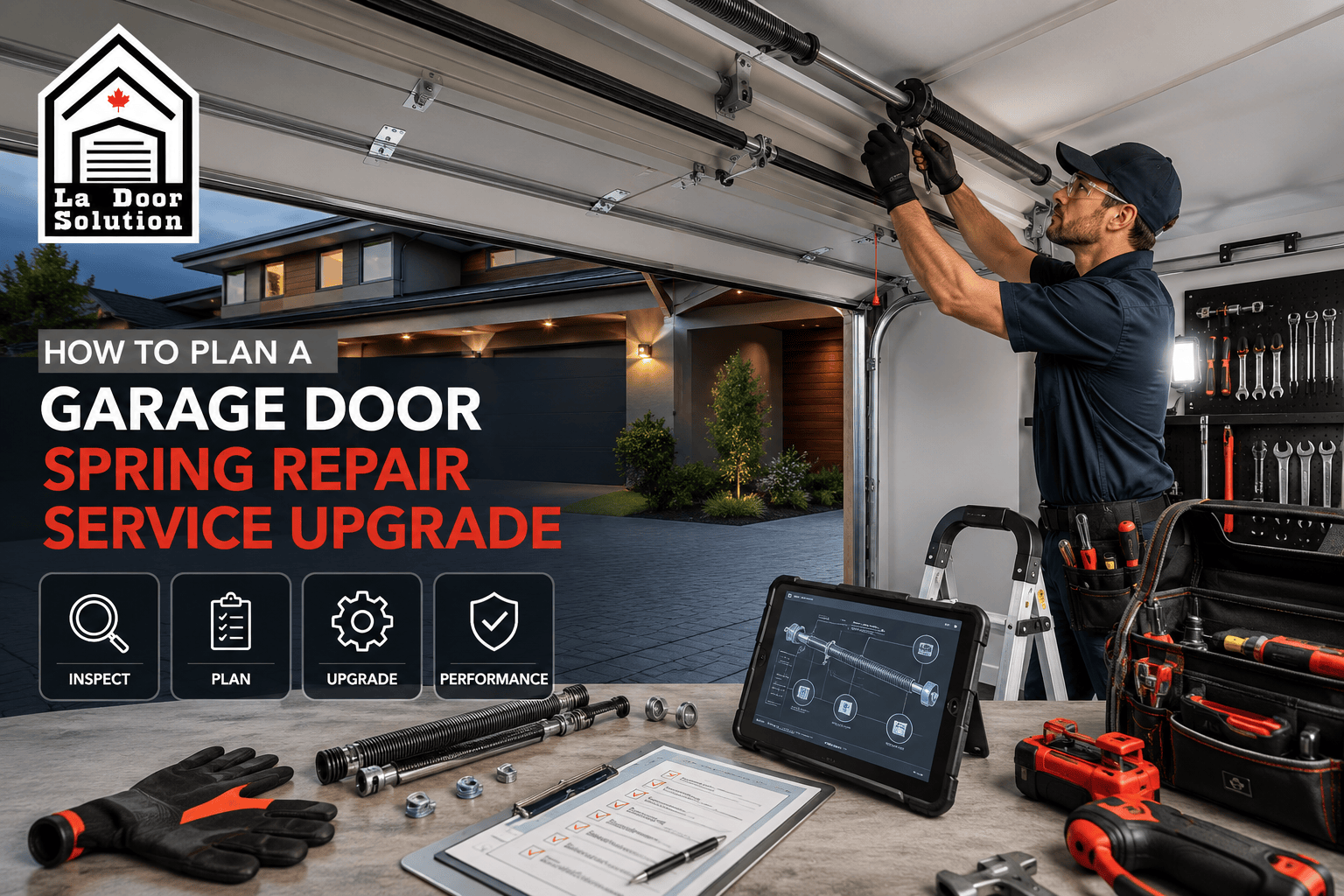
Spring replacement should be handled by someone experienced with garage door systems. Springs are under significant stored tension, so they are not a suitable DIY repair for most homeowners.
Lifting cables work with the spring and drum system to raise and lower the door evenly.
If a cable comes off the drum or breaks, the door can become crooked or partially detached from its normal lifting mechanism.
Continuing to operate the opener in this condition may increase the damage.
Tracks guide the rollers as the door moves.
Minor alignment issues may sometimes be corrected during routine service, but a severely bent or displaced track can prevent safe operation.
If rollers are coming out of the track, do not repeatedly activate the opener.
Unexpected movement is one of the more serious garage door symptoms.
Possible causes include sensor problems, control issues, mechanical imbalance, or other faults. A door that behaves unpredictably should be taken seriously because people, pets, and vehicles may be in its path.
Not every noise is an emergency, but sudden changes deserve attention.
Examples include:
A technician can determine whether the sound comes from the opener, rollers, hinges, tracks, springs, or another component.
Homeowners sometimes assume that every garage door failure is an opener failure.
That is not necessarily the case.
The opener provides powered movement, but it is only one part of the complete system.
If the door itself is mechanically damaged, installing or replacing an opener may not solve the underlying problem.
For example, imagine an Edmonton homeowner presses the remote and hears the opener motor running. The door moves a few centimetres and stops. Repeated attempts produce the same result.
The instinct may be to replace the opener.
However, the actual cause could be excessive resistance from a damaged roller, a track problem, or a counterbalance issue.
This distinction matters because replacing a functioning opener when the real problem is mechanical can lead to unnecessary expense.
A proper inspection should consider the entire door system rather than focusing on the first symptom.
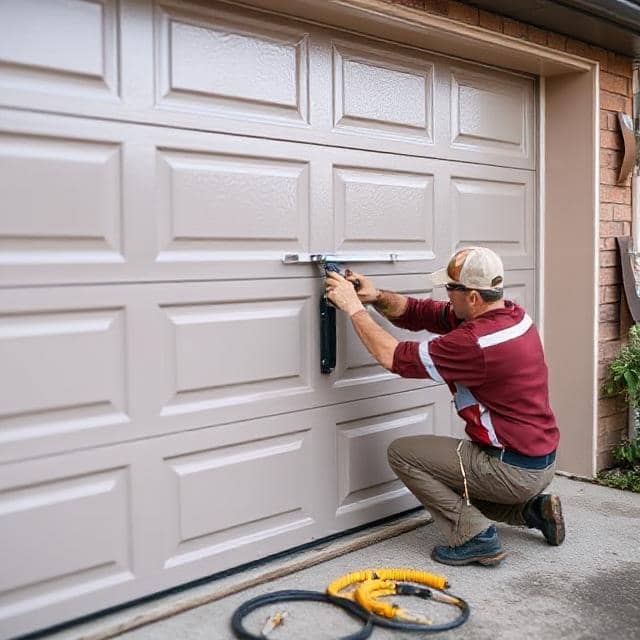
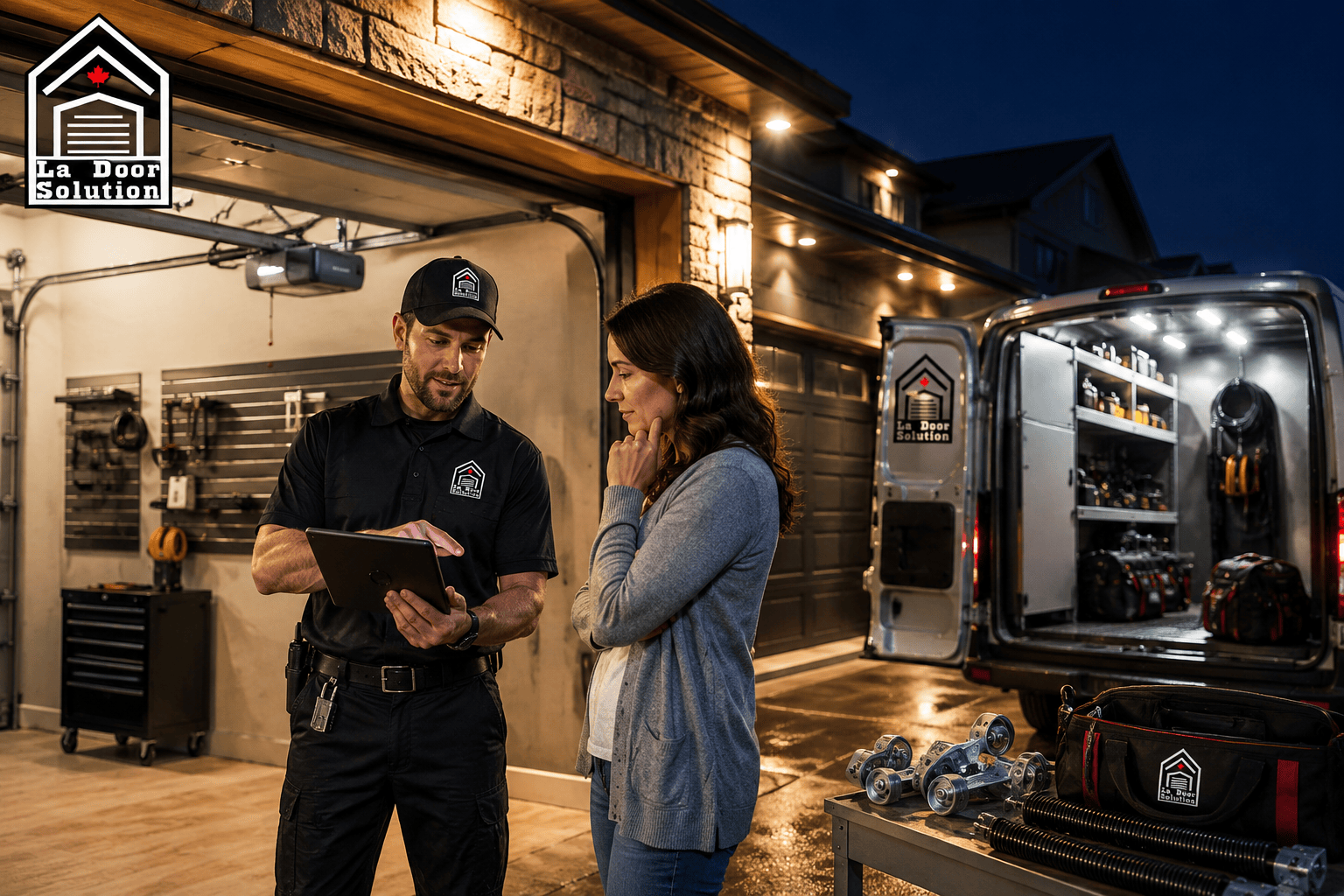
When you contact a technician for fast garage door repair in Edmonton, a thorough assessment should begin before components are replaced.
A typical inspection may consider:
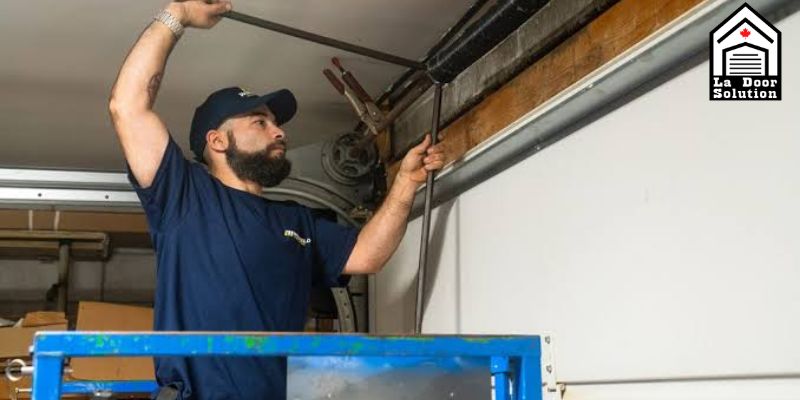
The technician checks how the door behaves when manually operated, where it is safe and appropriate to do so.
A properly balanced door should not feel excessively heavy or drop unexpectedly.
Springs are inspected for visible damage, wear, and other signs of failure.
The technician checks whether cables are properly seated and whether there is visible fraying, damage, or displacement.
The tracks should provide a consistent path for the rollers. Bent tracks, damaged rollers, or loose hardware can interfere with smooth movement.
These components connect sections of the door and help maintain its structure during movement.
The opener may be assessed for motor response, drive mechanism operation, control issues, and other symptoms.
Photo-eye sensors help prevent the door from closing when an obstruction is detected. Their alignment and operation should be checked when relevant.
The goal is not simply to identify what is broken. It is to understand why the system stopped working.
There are a few low-risk checks you can perform.
First, determine whether the opener has power. If the entire garage has lost electricity, the opener may not be the actual problem.
Next, check the remote battery if the wall control works but the remote does not.
Look at the photo-eye sensors near the bottom of the tracks. If they are visibly blocked or dirty, carefully remove the obstruction without disturbing the wiring or mounting.
You can also check whether the garage door is visibly crooked or whether anything is obstructing the tracks.
However, avoid attempting repairs involving:
A visual inspection is one thing. Disassembling a loaded garage door mechanism is another.
Edmonton’s climate can be hard on exterior and mechanical components.
Cold weather can affect lubricants and increase resistance in moving parts. Moisture and debris can also contribute to operational problems over time.
A common scenario is a homeowner attempting to open the garage door during a cold morning and hearing the opener operate without normal door movement.
The wrong response is to keep activating the opener repeatedly.
Instead, stop and determine whether the door is physically frozen, mechanically damaged, or experiencing another fault. If the system cannot be safely assessed, professional assistance is appropriate.
Weather does not automatically cause every failure, but seasonal conditions can expose components that were already worn or marginal.
Understanding the difference can help homeowners make better decisions.
Routine maintenance is generally about preventing problems before they become disruptive. It may include inspecting moving components, checking hardware, cleaning appropriate areas, and assessing door operation.
Emergency repair is reactive. Something has already failed or created a condition that prevents safe or normal use.
For example:
Routine concern: The door has gradually become noisier over several weeks.
Emergency concern: The door suddenly falls crooked, and one cable comes loose.
The first situation deserves service soon. The second requires the system to be taken out of normal operation until the problem is assessed.
If the door is mechanically jammed, repeatedly activating the opener will not necessarily fix the problem.
It can place additional strain on the opener and other components.
Garage door springs store substantial mechanical energy.
Without the appropriate knowledge, tools, and procedures, attempting replacement can result in serious injury or additional equipment damage.
A door that is sitting unevenly may indicate a cable, spring, roller, or track problem.
Forcing it can make the condition worse.
A new grinding or popping sound is often an early warning that something has changed.
Addressing a developing problem before a major failure can sometimes prevent a more disruptive breakdown.
The cheapest quote is not necessarily the most economical solution.
A repair should account for the actual cause of the problem, the condition of related components, and whether the proposed work addresses the underlying failure.
Ask what has failed, why it failed, and what work is being recommended.
Most automatic garage door systems have a manual emergency release mechanism.
Know its location before an emergency occurs. However, using it does not mean you should manually force a damaged or dangerously unbalanced door.
Avoid storing objects where they can interfere with the photo-eye sensors or the door’s travel path.
A door that gradually becomes slower, louder, or less smooth is giving you useful information.
Do not wait until the system completely fails before investigating.
If the problem occurs intermittently, note what happens.
For example:
These details can help a technician diagnose the issue more efficiently.
When selecting emergency garage door service in Edmonton, focus on competence and transparency rather than promises alone.
Ask practical questions such as:
A trustworthy repair process should leave you understanding what happened and what was done.
Repair is not always the right long-term solution.
If an opener is severely worn, repeatedly failing or no longer suitable for the door, replacement may make more sense.
The same principle applies to heavily damaged door components. Replacing one worn part may temporarily restore operation while leaving other significant problems untouched.
A professional should explain the options rather than automatically recommending the most expensive solution.
For homeowners, the useful question is not simply, “How much will the repair cost?”
It is also, “What solution gives me a safe and reliable garage door system?”
Garage doors combine electrical controls with substantial mechanical forces.
That combination makes diagnosis important.
A technician who only resets the opener or replaces the most obvious component may restore operation temporarily without solving the underlying cause.
A more complete assessment considers the relationship between the opener, door weight, springs, cables, tracks, rollers, sensors and controls.
That approach is particularly important when dealing with recurring Emergency Garage Door Problems in Edmonton.
Start by checking whether the opener has power and whether the remote or wall control responds. Look for obvious obstructions and check whether the photo-eye sensors are visibly blocked. Do not force the door if it feels unusually heavy, crooked or mechanically unstable. If there is a broken spring, loose cable, damaged track or another mechanical failure, stop operating the system and arrange professional assistance.
You may need urgent assistance when the door presents a safety concern, prevents essential vehicle access, is stuck in a dangerous position, has a broken spring or cable, closes unexpectedly, or has suffered significant mechanical damage. A minor remote-battery issue generally does not have the same urgency. The key consideration is whether continuing to use the system could create additional damage or risk.
Garage door spring replacement is generally not a suitable DIY task. Springs are part of the counterbalance system and can store substantial mechanical energy. Incorrect removal or installation can cause serious injury or damage. A qualified technician can identify the appropriate spring configuration and safely carry out the repair.
The source could be worn rollers, hinges, tracks, springs, bearings, opener components or other mechanical parts. A sudden popping sound can be particularly important because it may accompany a spring or cable failure. Avoid assuming that lubrication will solve every noise. If the noise is new, severe or accompanied by abnormal door movement, have the system inspected.
Response times vary according to technician availability, location, workload, time of day and the nature of the emergency. When requesting service, clearly explain whether the door is stuck open, stuck closed, crooked, damaged or creating a safety hazard. Providing accurate information helps the technician understand the situation before arriving and determine what equipment or parts may be needed.
A garage door is easy to overlook when it works normally, but its importance becomes obvious the moment it fails. A broken spring, damaged cable, failed opener or door that suddenly becomes stuck can interfere with daily routines and create genuine safety concerns.
For Edmonton homeowners, recognising the difference between a minor inconvenience and a genuine emergency is important. If the garage door won’t open emergency, the door is stuck closed, a spring or cable has failed, or the system is behaving unpredictably, avoid forcing it back into operation.
Professional 24/7 emergency garage door repair Edmonton can provide the assessment needed to determine the actual cause, make the system safe and identify the most appropriate repair or replacement option.
The best emergency repair is not simply the one that gets the door moving again. It is the one that addresses the underlying fault and gives the homeowner a clear understanding of what happened, what was repaired and what should be watched going forward.