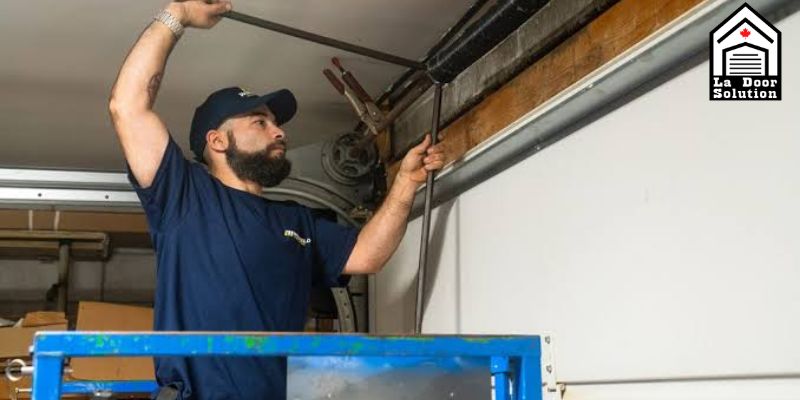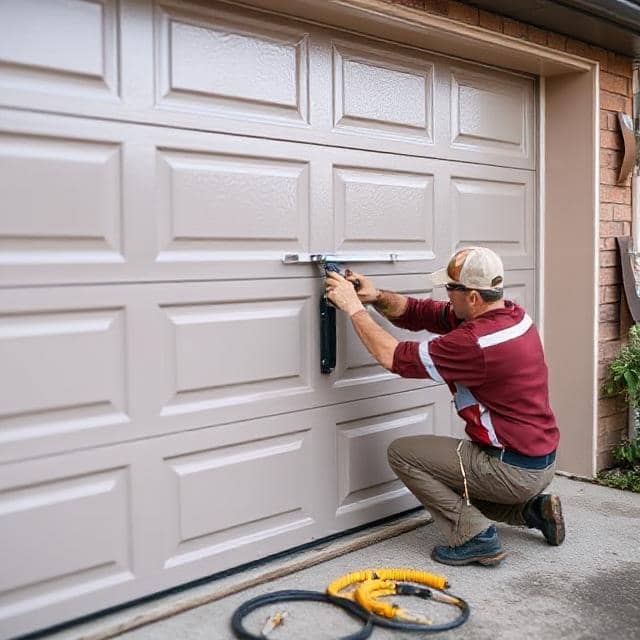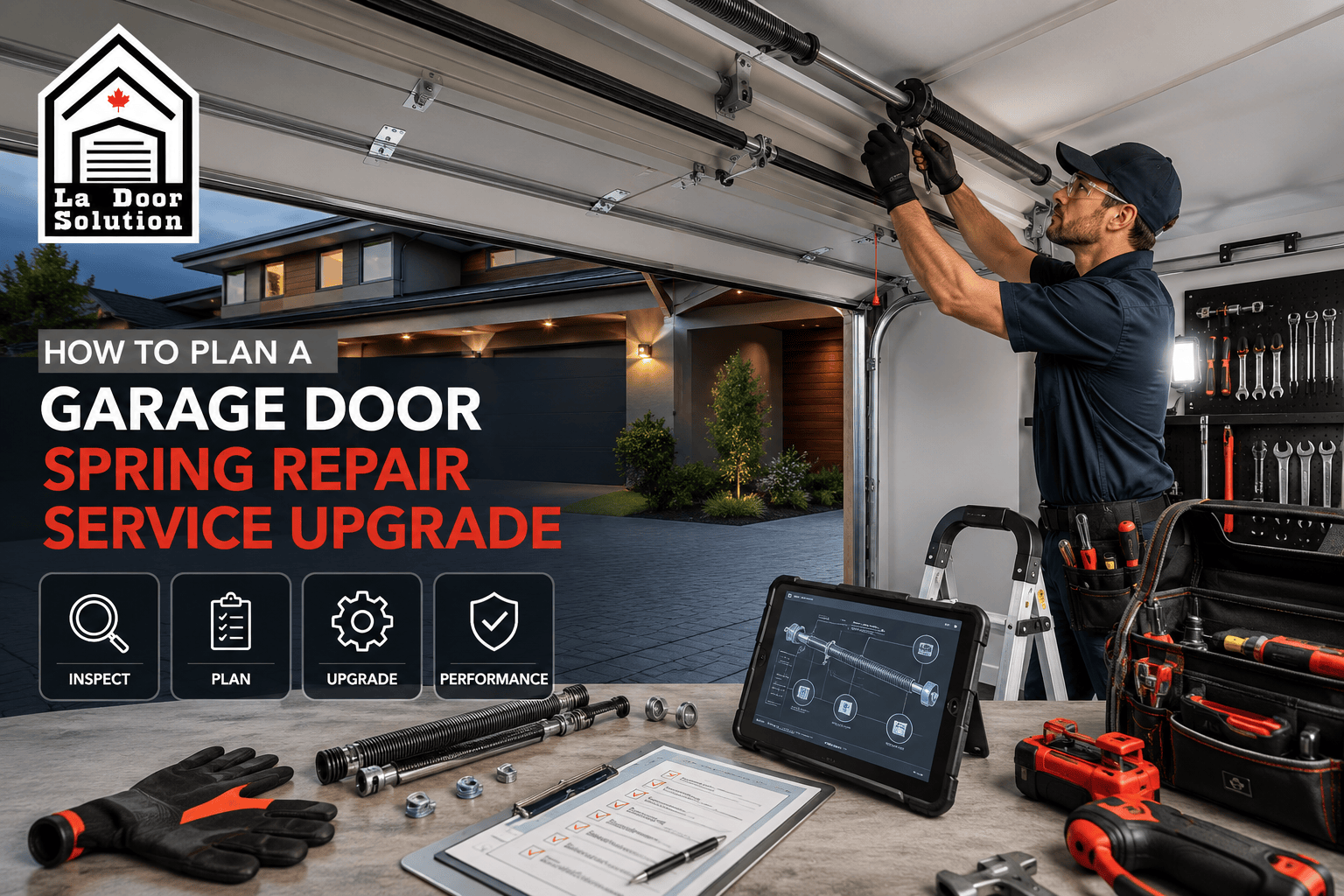


A garage door can weigh hundreds of pounds, yet it is designed to move smoothly with surprisingly little effort. The reason is the spring system. Garage door springs counterbalance much of the door’s weight, allowing the opener and other components to operate without carrying the entire load.
When those springs begin to weaken, the first signs are often easy to dismiss. The door may become slightly heavier, make a new sound, open unevenly, or stop halfway. Many homeowners continue using the door because it still works.
That can be a costly mistake.
Early garage door services in Edmonton can address developing problems before a worn or broken spring causes a door to become stuck, fall unexpectedly, damage other components, or leave your vehicle trapped inside.
This guide explains seven practical warning signs to watch for, why Edmonton’s climate can make garage door maintenance particularly important, and what homeowners should do when a spring appears to be failing.
Garage door springs are part of the counterbalance system. Their job is to offset much of the door’s weight so the door can be lifted and lowered in a controlled manner.
There are two common spring arrangements:
The exact configuration varies by door design.
A spring does not simply make the door easier to open. It also affects the balance and movement of the entire system. When spring tension is incorrect, other components may experience additional stress.
That is why a spring problem should not be viewed as an isolated hardware issue.
If the spring is deteriorating, the opener, cables, rollers, hinges, and tracks may also be affected by the changed operating load.
One of the clearest warning signs is a garage door not opening normally.
You may notice that:
A broken spring can prevent the opener from lifting the door because the motor is not designed to carry the full weight of the door on its own.
However, a door that will not open does not automatically mean the spring is broken. Other possibilities include opener faults, damaged cables, track problems, lock engagement or obstruction.
This is where professional diagnosis matters.
If the door suddenly becomes extremely heavy when operated manually, do not keep testing it repeatedly. A technician can determine whether the counterbalance system has failed.
A change in sound is often one of the earliest clues that something needs attention.
A garage door making noise may produce:
Not every noise originates from the springs.
Dry rollers, loose hinges, worn bearings, track problems and opener components can all create unusual sounds.
However, a loud bang can be particularly significant. Torsion springs can release stored energy when they break, sometimes producing a sound that resembles a gunshot or heavy impact.
If you hear a sudden loud bang and subsequently notice that the door is unusually heavy or will not open correctly, stop operating it and arrange an inspection.
A properly balanced garage door should not feel excessively difficult to move manually when the opener is safely disconnected according to the manufacturer’s procedure.
If the door suddenly feels much heavier, the spring system may no longer be providing adequate counterbalance.
This is particularly noticeable when:
A heavier door places additional demands on the opener and other mechanical components.
One Edmonton homeowner may initially assume that a struggling opener simply needs replacement. In practice, the opener may be reacting to a mechanical problem elsewhere in the door system.
That is why experienced garage door repair begins with diagnosis rather than immediately replacing the most visible component.
An uneven door is another important warning sign.
When viewed from the front, the bottom edge should generally move in a controlled and relatively level manner.
If one side rises faster than the other, possible causes include:
A damaged spring or cable can cause one side of the door to carry a disproportionate load.
Do not attempt to compensate by adjusting springs or cables yourself. These components can be under substantial tension.
An experienced garage door company can inspect the complete counterbalance system and identify whether the problem is actually the spring, cable, track or another component.
A garage door off track is a serious mechanical problem that should not be ignored.
You might notice:
A door can come off its track because of damaged rollers, impact, cable problems, misalignment or excessive mechanical stress.
A failing spring may contribute indirectly if the door becomes unbalanced, but an off-track door does not necessarily mean the spring is the original cause.
The safest approach is to stop using the door until it has been professionally assessed.
Trying to force an off-track door closed can bend tracks, damage panels or create a more dangerous failure.
Physical inspection can reveal obvious signs of spring failure.
For a torsion spring, a visible gap through the coil can indicate that the spring has broken.
You might also notice:
Do not touch or attempt to manually manipulate the spring.
Garage door springs store considerable mechanical energy. Even when a spring appears broken, other components may remain under tension.
A visual observation is useful information for a technician, but it should not become a DIY repair project.
Your opener can provide valuable clues about the condition of the door.
Signs include:
Homeowners sometimes replace the opener immediately because it appears to be the source of the problem.
But an opener that suddenly struggles to lift a door may actually be responding to increased mechanical resistance.
A technician should evaluate the door’s balance, springs, cables, rollers and tracks before concluding that the opener itself has failed.
Edmonton experiences significant seasonal temperature changes, and garage doors are exposed to those conditions every day.
Cold temperatures can affect lubricants, materials and mechanical movement. Moisture and road salt can contribute to corrosion in exposed components. Repeated seasonal expansion and contraction can also affect mechanical systems over time.
This does not mean cold weather automatically causes a spring to fail.
Garage door springs have a finite cycle life, and normal use gradually fatigues the metal. Environmental conditions can add to the overall maintenance demands of the system.
For Edmonton homeowners, seasonal inspection can therefore be a sensible preventative measure.
Not every spring issue requires an emergency call.
However, urgent attention is appropriate when the door presents an immediate safety or property risk.
Examples include:
If the door is unstable, keep people and vehicles away from the area.
Do not repeatedly activate the opener in an attempt to force the door to move.
This is particularly important if you suspect the spring or cable system has failed.
The first step is to stop operating the door.
Do not attempt to:
Instead, keep the area clear and arrange professional assistance.
If the garage door is closed, you may need to make alternative arrangements for accessing your vehicle until the system can be safely repaired.
A qualified technician can assess the spring type, door weight, hardware condition and overall balance before carrying out the appropriate repair.
You cannot prevent spring fatigue indefinitely. Springs are wear components.
You can, however, reduce the likelihood of unexpected failures by paying attention to early symptoms.
Routine garage door service can identify developing problems before they become major failures.
A professional inspection may examine:
The inspection should be appropriate to the door’s age, condition and usage.
Homeowners interact with their garage door frequently, which means they are often the first people to notice changes.
A new squeak may seem insignificant.
A sudden grinding sound may be more meaningful.
A loud bang followed by a heavy door is especially important.
Treat changes in operation as useful diagnostic information rather than waiting until the door stops completely.
Garage door spring replacement is not comparable to replacing a household light bulb.
Spring systems can store substantial mechanical energy, and incorrect handling can cause serious injury or property damage.
Spring repair and replacement should be handled by a suitably trained professional.
Not necessarily.
A door can continue functioning despite a developing mechanical fault. Continuing to operate it may increase wear on the opener and other components.
If the door has become unusually heavy, uneven or noisy, arrange an assessment rather than waiting for complete failure.
Lubrication may help certain moving components operate more smoothly, but it does not restore a fatigued or broken spring.
If a spring has lost its mechanical integrity, lubrication is not a repair.
No.
Garage door springs need to be correctly matched to the door system. Using an inappropriate spring can affect balance and operation.
Spring selection should be based on the door’s specifications and counterbalance requirements rather than simply choosing the strongest available option.
When arranging garage door repair near Edmonton, homeowners should ask practical questions.
Consider asking:
A good technician should be able to explain the problem in straightforward language.
You should not need to accept a vague recommendation such as “the whole system needs replacing” without understanding why.
Spring failure does not automatically mean you need a new garage door.
In many situations, the door itself may be structurally sound while the spring or another mechanical component has reached the end of its service life.
Replacement may become more appropriate when the door has:
A professional assessment can distinguish between a component-level repair and a genuine need for replacement.
If an existing garage door has reached the end of its useful life, garage door installation Edmonton services may be worth considering instead of continuing to repair an ageing system.
Installation decisions should consider:
A correctly selected door can improve reliability, but installation quality is equally important.
The goal should be a properly balanced system where the door, spring assembly, tracks and opener work together.
The opener gets most of the attention because it is powered and visible.
But the door itself is the mechanical system being lifted.
Changes in balance, resistance or movement can tell you more about developing problems than the motor sound alone.
If your garage door operated normally for months and suddenly becomes noisy, heavy, or uneven, investigate the change.
Mechanical problems rarely improve by themselves.
Do not store objects where they can interfere with the door’s travel path.
Even a relatively small obstruction can affect movement or create additional stress.
Spring tension is not something to experiment with.
If the door needs adjustment, have the appropriate professional assess it.
A broken spring is not simply a minor inconvenience. The door’s balance has changed, and other components may be affected.
The safest response is to stop operation and have the system assessed.
Waiting until a garage door becomes completely unusable can turn a relatively straightforward repair into a larger mechanical problem.
For example, a weakening spring may initially cause the opener to work harder. Continued use can place additional stress on the opener, cables, rollers, and other components.
Early garage door spring repair in Edmonton can help address the counterbalance issue before secondary damage develops.
That does not mean every unusual noise will lead to an expensive repair. It means the problem should be diagnosed while the symptoms are still manageable.
Garage door springs are easy to overlook because they operate quietly in the background when everything is working correctly.
The warning signs become much more obvious when you know what to watch for.
A garage door not opening, unusual noises, increased door weight, uneven movement, a garage door off track, visible spring damage, and a struggling opener can all indicate that professional attention is needed.
For Edmonton homeowners, early diagnosis is particularly valuable because seasonal weather, frequent use, and normal mechanical wear can gradually affect garage door components.
If you notice these warning signs, avoid forcing the door or attempting spring adjustments yourself. A qualified technician can determine whether the problem involves the spring, cables, tracks, opener, or another component.
Ultimately, timely garage door services in Edmonton are not just about getting the door moving again. It is about maintaining a balanced, predictable, and safer garage door system before a developing fault becomes an emergency.
A broken spring may cause the door to become extremely heavy, refuse to open, open only slightly, or remain closed while the opener operates. With torsion springs, you may also see a visible separation in the coil.
Do not touch the spring or attempt to test its tension manually. Other components can remain under load even after the spring has broken. Professional inspection is the safest way to confirm the failure.
It is generally best not to force or repeatedly operate a garage door with a suspected broken spring. The door may be significantly heavier than normal and could become unstable.
Trying to lift it manually can also create additional risk of injury or damage. Have the counterbalance system inspected before attempting further operation.
Spring lifespan is commonly discussed in terms of operating cycles rather than simply years. One cycle generally means one complete opening and closing of the door.
Actual lifespan depends on spring quality, door weight, usage frequency, environmental conditions and maintenance. A frequently used garage door can reach its spring’s rated cycles sooner than a door used only occasionally.
No. Noise can come from rollers, hinges, bearings, tracks, the opener or other moving parts. However, a new or increasingly loud noise should not automatically be dismissed.
If the noise occurs alongside a heavy door, uneven movement, difficulty opening or a sudden bang, professional assessment becomes particularly important.
There is no single interval that suits every garage door. Usage, age, environment and condition all matter.
A practical approach is to monitor the door regularly yourself and arrange professional service when you notice changes in movement, balance, noise or safety operation. Older or heavily used systems may benefit from more frequent professional attention.
If you are considering garage door services in Edmonton, choose a qualified provider who can inspect the complete door system rather than focusing only on the component that first appears faulty.